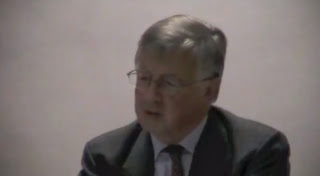
Former Deputy Daniel Wimberley.
In little more than twenty four hours the Jersey Child Abuse Committee of Inquiry will (should) be publishing its long-awaited report. (3:pm Monday July 3rd 2017)
Ahead of its publication former Jersey politician, and Anti Child Abuse Campaigner, Daniel Wimberley has put together a number of crucial questions which need to be addressed and "what to look out for" in the report.
Submission (to VFC) of Daniel Wimberley.
Hillsborough is in the News right now – it took 28 years and a series of inquiries before the truth finally was uncovered, and prosecutions brought. I am sure we all want to believe that the Abuse Inquiry here in Jersey gets it “right first time”. But will it?
I have my doubts, and we need to be ready, as a team, to go through this report at speed and test it to see if it is reliable. The media will want comment and we should be ready to respond with reasoned views, whichever way they go, as soon as we are able.
So, in this post I list some standout moments, moments which encapsulate key issues for the panel. These startling admissions or contradictions in the evidence must have registered with the Panel.
To do a quick audit of the Report we can focus on how the Panel deals with these key moments. We can see if they have been paying attention and if their conclusions are likely to be well-founded.
And if they have ignored, or missed these moments, then it is likely that the Report and its conclusions, in the relevant areas, will not be of much use, and a sad waste of money.
Let us hope that they have done the job properly, it is all we can hope for.
Please add your own standout moments in comments, additions to lists of examples etc..
If you want to help with the team readathon, let Voice know. We assume the Report will be searchable so it should be possible to type in a string of words and find them. If there are hard copies available, we assume they will have a comprehensive index.
So, here goes . . .
Former DCO/SIO Lenny Harper.
STARTING AT THE TOP . . .
The relationship between Senior Investigating Officer Lenny Harper (LH), and Attorney General (AG), William Bailhache (WB)
Question 1:
Is Paragraph 36 of LH’s First witness statement referred to at all in the Inquiry report? If it is, how is it treated?
NOTES
At stake here is the credibility of on the one hand the Senior Investigating Officer, and on the other the prosecuting authority.
Here is para. 36:
“I cannot recall any occasions where the Attorney General did agree to charge employees of the SOJP in relation to malpractice/corruption. Even where we had caught members of the IT department fraudulently buying computers and recording equipment for their own use at home, use which included taking topless photos of their wives, the Attorney General refused to take action. There was even one occasion where we had CCTV evidence of a particular Special Branch Officer indulging in sexual activity in the Special Branch office with a foreign national, and then letting her look at confidential papers on terrorism, and yet no charges were brought.”
The whole issue of LH’s mistrust of the AG is in this paragraph. Why were some at least of these cases not prosecuted?
I have searched on WB’s witness statement and the transcript of his hearing for the words “equipment” “recording” Special” Branch” and “CCTV” and there were no results.
NB The Boschat affair was covered by the Inquiry from both sides. The letter of advice for the then SG Stephanie Nicolle is reproduced as an Exhibit of WB’s witness statement.
The gist of her letter is that the goings-on between the police officers involved, especially Sean Osmand, and Boschat himself appear to be not right, but that there was not enough evidence to prosecute. Her letter is in WB’s exhibits. (It is 95% not there, replaced by a series of solid black squares.)
It could be that the Panel were able to read other background about the matters in paragraph 36. Then we will see if that is so from their report.
Former AG/current Bailiff William Bailhache
Continuing with WB
Question 2:
(again, what is at stake is his credibility) Does the Inquiry report consider the discrepancies in the 2 extracts below, is the Report’s analysis thorough and convincing, and what conclusion does it come to?
Extract 1
The AG’s letter (not sure to whom) says: "He (witness K”) received consistently good reports from those responsible for monitoring and evaluating his performance."
When “MR. K.” is questioned about this by Inquiry Counsel Patrick Saad, Mr. K. says the reports, and, monitoring, didn’t exist. More precisely, there were no WRITTEN reports, only verbal ones. But the words of the AG William Bailhache suggest written formal reports.
Extract 2
William Bailhache’s June 2009 public statement says about allegations of cigarette burns: ..… but there is no physical sign of any injury”
But from Jason Payne-James registered medical practitioner, and specialist in forensic and legal medicine’ we get this: "On examination of his back there were numerous pale mature scars generally less than ... in size down to about [so much] in size. They extended across [an area of the back], they were in no fixed pattern and of no particular shape. They represent areas of skin that have sustained damage of an extent enough to result in residual scars. Causes could include cigarette burns” From his report for the redress scheme, written June 2014
Former Home Affairs Minister/current Deputy
Andrew POWERGATE Lewis.
Andrew Lewis (AL) and connected issues
Question 3:
Does the Inquiry report say AL lied to the inquiry panel on oath? Or that he lied to the States? If not, how do they come to that conclusion, and is their reasoning credible?
If they conclude that he did lie, and if they suggest a prosecution or similar process of some kind, do they address the conflict of interest which will then arise between the AG’s role as lawyer for the government (and therefore, of Ministers) and the AG’s role as public prosecutor?
NOTES
On December 2 2008 AL made a statement to the States announcing the suspension of Chief of Police (COP) Graham Power (GP). During the questions and answers which followed the statement he said the following words:
“I have read an alarming report from the Metropolitan Police which led me to this decision (to suspend GP) in the first place.” ………………………
"As far as the accusation you raise about the Metropolitan Police, when I saw the preliminary report I was astounded. So much so that my actions, I believe, are fully justified. If the preliminary report is that damning, Lord knows what the main report will reveal. So my successor will have an interesting time. The report that I was shown gave me no doubt at all." (My emphasis)
But in the report by Brian Napier QC (para. 101) we read:
"As previously has been noted,
neither Mr Lewis nor Mr Ogley saw the Interim Report. Neither did they seek to see it. The reason given was the nature of the information that was contained therein. It was, said Mr Ogley, a police document and it was inappropriate that he (or anyone else) should have access to it. Mr Ogley says that
he was told both by the Attorney General and Mr Warcup that he should not look at the interim report and neither he nor Mr Lewis did so." (My emphasis)
Conflicts of interest
Question 4:
Including the Lewis case, does the Report address the conflict of interest between the AG’s role in Jersey as lawyer for the government (and therefore, of Ministers) and the AG’s role as public prosecutor? What steps do they suggest to deal with this, and are they adequate?
Sir Philip Bailhache
Question 5:
Does the Inquiry report say anything at all about the words spoken by the Bailiff (Sir Philip Bailhache) to AL, telling him in effect to stop speaking about the Met Interim Report. in the extract below? (For those who have not considered these words before, I suggest you take a close look, and reflect on their significance.)
These words were spoken in the in camera Q&A with Home Affairs Minister Lewis, about why he has just suspended the Chief of Police Graham Power.
The Deputy of St. John (Andrew Lewis):
"I am bringing a Chief Officer to account. I am giving him every opportunity to defend himself. As far as the accusation you raise about the Metropolitan Police, when I saw the preliminary report I was astounded. So much so that my actions, I believe, are fully justified. If the preliminary report is that damning, Lord knows what the main report will reveal. So my successor will have an interesting time. The report that I was shown gave me no doubt at all ..."
The Bailiff:
Minister, do not go down this road, please.
The Deputy of St. John:
... that the actions that I took were justified and we will await the outcome of the investigation as to whether it was.
Now why would the Bailiff say such a thing? This is about whether the Panel were inquisitive about what is going on.
Andrew Lewis not getting any advice sent to him direct
Question 6:
Does the Inquiry report set out clearly exactly who in the LOD sent what advice to whom and when about the possible suspension of GP, people such as head of Human Resources Ian Crich, and Chief Executive, Bill Ogley?
Does the Inquiry report consider why Lewis was never (so far as I know) sent legal advice by the Law officers even though he was the Minister for Home Affairs (MHA) and as such the only person who can suspend the Chief of Police?
Andrew Lewis and how the suspension of GP was approached
Question 7:
Does the Inquiry report consider why Lewis could say things like what is quoted below, from the transcript of Day 136 and what conclusions does it draw?
Ms McGahey, Counsel to the Inquiry, asking about the phone call made by AL to GP on the evening before the suspension meeting on November 12th 2008:
“You didn't tell him, did you, that you were going to consider his suspension?
A. (Andrew Lewis) Why would we want to do that?
Former CEO Bill Ogley.
Chief Executive (CE) Bill Ogley (BO) and how the suspension of GP was approached
Question 8:
Does the Report consider the legal advice which Bill Ogley had received from the Law Officers about suspending Chief of Police Graham Power? Is the way it does this thorough and convincing, and what conclusion does it come to?
NOTES
Ms McGahey to Bill Ogley:
Q. ………. But he (the AG) is the principal Law Officer. You have in your hands an email and absolutely it is in parentheses in the context of an email principally about the press statement, that says "Surely you will want to have the full Met report before you suspend". Is that expression of opinion not worthy of being taken very seriously?
…………………………..
Q. Did you know that the Solicitor General had advised that you should ensure that the interim report from the Metropolitan Police didn't have any caveats or qualifications in it before you relied on it as a basis for suspension?
A. We were not allowed to see the interim report, or be aware fully of its contents.
Q. And so you didn't know whether it had any qualifications or caveats?
A. No. And I'm not sure that I know of that advice. If you could put it before me I would be interested to see it.
The only person who knew of the caveats was Deputy Chief of Police David Warcup (DW). Bill Ogley here seems to be handing him the responsibility of telling other people about these caveats. How does the Report deal with this?
Bill Ogley, Andrew Lewis, and lying
Question 9:
How does the Inquiry Report deal with what Bill Ogley and Andrew Lewis told the Wiltshire Police investigation (Operation Haven) about the dates of the letters written to GP about his suspension? Does the Inquiry come to the conclusion that they lied (see below), what is its reasoning, and what conclusions do they draw?
NOTE
My notes show that both BO and AL lied to (or “misled”) Wiltshire about the dates in what are effectively sworn statements, but I may be wrong on this. Can someone please confirm this and give references, preferably from Inquiry evidence?
Destruction of evidence.
Question 10:
Does the Inquiry report have a section on this crucial issue, drawing together all they have been told and drawing conclusions? Did they truly inquire about the various instances they were told about?
Former Deputy Trevor Pitman.
NOTE
My impression has been that they are unaware of the importance of this issue and completely lacking in any desire to inquire (Inquiry – the clue is in the title) But I may be wrong.
Here are five cases which I remember – please commenters, tell about others.
a) Mario Lundy (Director of Education) witness statement paragraph 24 says that a manager who joined . . . . destroyed the day books
b) Trevor Pitman’s witness statement where he mentioned 4 (if I remember correctly) boxes which were found, handed over to a “senior” person, signed for and then disappeared.
c) Hewlett witness statement or transcript, but no reference, sorry
d) “chaotic filing” at Childrens’ Services no reference, sorry
e) LH witness statement (if I remember correctly) refers to missing records
the skull and the coconut
Question 11:
Does the Inquiry come to a sensible and defensible position on this question? And what was the role of the media and politicians in highlighting this one object, and how does the Inquiry evaluate their motives for doing this?
NOTE
There is only one possible position, is there not? An object with collagen in it cannot be the same object as an object with no collagen. So the piece identified originally as maybe a fragment of a child’s skull, and which when sent away for testing, had collagen is not the same object as the “piece of coconut”. But this involves some awareness of what can and does go on at forensic testing establishments. LH refers to it a statement he makes somewhere, but did he tell the COI? Did they ask?
LH’s handling of the media
Question 12:
Does the Report make a clear distinction between what Harper said and wrote and what a) others like Ben Shenton and Frank Walker said that he said and b) what the media said that he said? Does the Report come to a balanced view about the pros and cons of his media approach?
Judges’ attacks on LH
Question 13:
How does the Report describe and interpret the appearance on front pages of the JEP of judges Montgomery and Pitchers, both with headlines and copy attacking Harper?
Does the Report analyse these attacks and their refutation by LH? Did the Panel fulfil their duty to inquire into how these assertions came to be made within judgements and how these highly controversial assertions came to court and were dealt with in court?
NOTE
There is a huge amount at stake in the answers to these questions. They are linked to the answer to Question 5. Were the Inquiry Panel interested in the possibility of a politicised judiciary? Were they inquisitive about this possibility?
Accusations that LH and GP created a bullying culture in the States of Jersey Police (SoJP)
Question 14:
How does the Inquiry report cover this issue?
Former Home Affairs Minister Ian Le Marquand.
NOTE
The accusation of bullying by LH and GP was a vital part of the “war” waged by in particular Minister for Home Affairs Ian Le Marquand to discredit the top team at the Police.
It is of course a very serious accusation, particularly in a uniformed organisation such as the Police with strict lines of command. LH says this (first witness statement paragraph 23 and second witness statement paragraph 57):
“Quite early on in my career at the SOJP, it was clear that many Jersey politicians did not approve of our efforts to tackle bullying. We were openly criticised in the media by these people and on one
occasion were referred to as the 'politically correct KGB stalking the corridors of police headquarters.”
……………..
Mr Gradwell claims that there was a culture of bullying among senior officers within the force, naming myself, Graham Power, Shaun Du Val, and David Minty. He seems to have turned this on its head. I had to take firm action on arrival within the force to stop a minority of officers from bullying, but it had nothing to do with the senior ranks of the force. These matters included assaults, inappropriate behaviour and comments, and even holding a gun to an officer's head, as well as racist abuse. I detail a number of these incidents in my exhibit LH/l. The records of each case should still be available at Police Headquarters. Despite being labelled the "politically correct KGB stalking the corridors of Police Headquarters" by one politician, we were very successful in dealing with this, to the extent that officers were happy to report incidents to us.
Ian le Marquand was forced by GP to publicly withdraw accusations of bullying.
Former Health Minister Stuart Syvret.
Removal of Stuart Syvret (SS) from ministerial post
Question 15:
Does the Inquiry report recognise the importance of this dismissal and tackle this subject in detail, fairly and robustly? Were SS’s criticisms of the childrens’ services right? Was Mike Pollard’s letter to all staff criticising the actions of the Minister right? How does the Inquiry report deal with the “conspiracy” in the Civil Service – the 2 simultaneous meetings documented by the File Notes of GP and Alison Fossey?
Does the Report connect the removal of SS from his ministerial post to the sacking of social worker Simon Bellwood and the suspension of Graham Power? What conclusions does it draw about these events? Does the Report connect this apparent conspiracy with the apparent conspiracy surrounding the suspension of GP?
The role of the media
Question 16:
Does the Inquiry report analyse how the media in Jersey reported on the abuse which occurred, the investigation by the Police, the political dimension and so on? There are academic teams who do content analysis of media – did the Inquiry commission research?
Were the media objective and unbiassed? Were they challenging? Does the Inquiry report consider both traditional and internet? Has the Report described the impact media had on politics and society in the area of child sexual abuse in the past and has the Inquiry report made robust and useful recommendations about the role that the media could play in the future to help bring about a society free from child abuse
Does the Inquiry report explain why they called no editor or journalist as a witness?
NOTE
It is as if the Panel did not think the media were part of the TOR, But they most certainly are. See TOR 4 “Examine the political and societal environment during the period under review . . .”
IN CONCLUSION
I have left out many areas, concentrating on the political and social issues. This is long enough as it is.
I think that they will actually do the job on Childrens’ Services and how they failed and ways to improve them. I have far less confidence about the areas focussed on here.
I have not covered recommendations for the future, that is a separate task. First we need to know if the Committee of Inquiry’s diagnosis of what went wrong and why it went wrong is based on a real understanding of the issues.
I hope that this list of some key issues is useful, and that people add their own issues, and add their own examples e.g. of evidence which has gone missing.
Daniel.